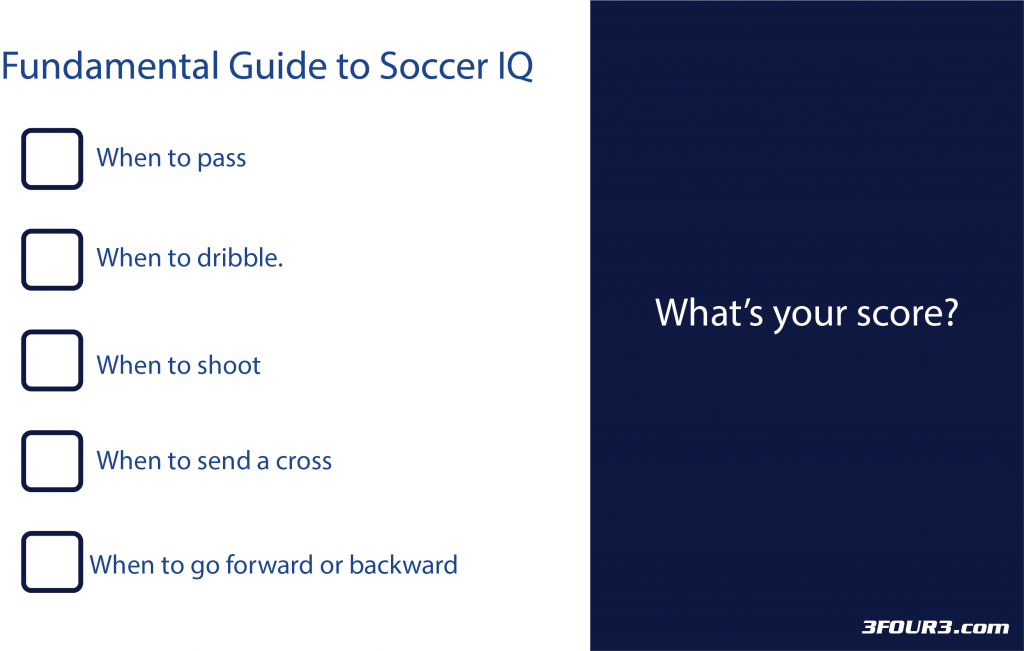
 I think we can all agree that Soccer IQ is about decision making.
– When to dribble.
– When to pass.
– When to shoot.
– When to send a cross.
– When to go forward or backward.
– etc.
Disagreements arise on what is the correct thing to do – the reason for the different styles of play.
While the correct decisions are sometimes governed by the current scoreline, run of play, the opposition, time on the clock, etc., what most people fail to realize is the most fundamental guide. The correct decision, by and far, is the one that retains possession! All decisions to the contrary are risks:
- Trying to dribble by a player or two.
- Threading a pass to your midfielders or strikers.
- Launching a 40 yard ball to your forwards
- etc …
What are you risking? Well, a turnover and wasting what would have been a much better opportunity 2, 5, or 30 passes later.
Now, please don’t misinterpret! I’m not saying to play keep-away for 90 minutes – the objective is to score and not be scored on. What I am saying is that you want to increase your chances of success when taking these risks. And that comes with patience.
Meaning, keep knocking the ball around until a “good opportunity” presents itself. If it’s not there, for god’s sake don’t force it, make the simple play.
So while there are infinite situations to consider, many of which we’ll flesh out in other articles, the most fundamental thing everyone should understand is:
- If a player’s priority is evidently to play simple and retain possession: High Soccer IQ
- If a player’s priority is predominantly risk taking: Low Soccer IQ
What do you think?

Nice post. You are so correct. I think the perfect illustration of what you’re talking about is Argentina’s second goal against Serbia in the 2006 World Cup. It’s simply the best team goal in history, hands down: http://www.youtube.com/watch?v=z0O7KkZn4rk
It included 25 passes over 56 seconds, and every single move illustrated the principle here, but pay special attention to Cambiasso, #5. Watch him always looking to put himself in a useful position. Time after time, he’s there to take the pass, and after he’s moved the ball on, he’s on to the next spot. I think it was especially fitting that he ended up being the scorer.
I also think another big part of Soccer IQ is recognizing when you’re in a situation when you can take a big risk, and not be punished. I remember seeing a goal that Zlatan Ibrahimovic scored for Juve years ago. The ball was played up to him just past the center line. He flicked it on with his heel, turned, chased the ball down, outran a defender, shot from just inside the penalty area, and put the ball past the keeper. Brilliant stuff. Here’s the video: http://www.youtube.com/watch?v=MEOoE0XjeDw
What I’m sure you’ll notice from the video is that the moment was ripe for a risk. Ibrahimovic was well covered, with players ahead and behind, so holding the ball probably wasn’t the best choice. At the same time, Roma was holding an insanely high line and there were acres of space behind him. Now, if he flicks the ball on and he puts it in the wrong place, there’s a fair chance that a Roma defender could get to the ball. On the other hand, Juve was well positioned to defend at the moment, and if he puts it in the right place, well, we know what happened. Ibrahimovic showed big time Soccer IQ when he took that risk.
Excellent comment Carlos! It contributes so much for our readers.
I remember exactly where I was, what I was wearing, and how I felt when I witnessed that play against Serbia. I had a smile on my face during the whole buildup and got goose-bumps when they scored. It was incredible!
Your Ibra example is great as well. There are soooooooooo many different scenarios to illustrate and analyze. It’s just crazy to me, how this is not understood by the mass American soccer fan, coach, and players. They’ll cheer when a player’s decision was completely wrong, and they’ll criticize when the decision is “correct”. Most often this happens when a team is holding possession for a while …. let’s say greater than 10 passes. You’ll hear comments about how stupid this is – that it gets you nowhere.
I’ve got at least part of your answer, although I’m sure the question is rhetorical…Many US soccer fans, coaches, and players have grown up and grow up with no one teaching this concept of possession (technical and tactical), especially on the women’s side even in premiere clubs (it has gotten better, but the US still has a long way to go). It is my belief that this is due, in part, to the explosion of the sport here, and like companies which open too many franchises too soon to oversee great quality control (whether due to idealism, profit, notoriety, power…etc), the lack of knowledgable coaches has weakened the sport here before it’s really had a chance to solidify, creating generations of players who think they know but don’t…so the soccer system here is in a constant battle with itself. Another factor is the money put into the sport in the youth leagues. While this helps support “more knowledgable coaches” (a whole other discussion in itself…) and programs for those who have $, it doesn’t help those who perhaps have more natural talent and desire. The first group gets the contacts and the exposure and the latter group does not. The irony is that the ones who could best use the resources are not always the ones who have them; of course this is not a new problem. We have all seen affluent players go through the system with no passion, as we have seen a lot of passionate players who would bring up the quality of the game in the US much quicker but just need more and better resources. Although there are more community programs geared towards helping resolve this issue, they are just in their infancy. One more concept nags at me; Three things that help the US are 1) sheer numbers, so we’re bound to find and create good athletes or good talent to recruit every year feeding our national teams, 2) more and more people who are knowledgable, talented, and passionate about soccer migrate to the US every year, so while there are many citizens who never get to properly develop their talents here, others simply take their place, and 3) just like in most societies, we are developing better coaches each year with the continuing education of older open-minded and talented coaches and with the onset of a generation of young coaches who grew up in a passionate and effective soccer environment. There is hope. Can we tip the scales so that the knowledgable coaches reach more players than the not? Probably not any time soon, … maybe never, but if we keep the focus on using the $ more wisely in education of key coaches AND parents and in special programs to find and develop raw talent, we will see a significant difference in the next few generations of US national teams.
One more thought, Gary, that I’d like to hear your reaction on. It seems to me that while this style of play is associated with hugely talented teams like Argentina and Brazil, the technical skills required are actually not that advanced. The vast majority of individual actions in this move are trap, pass, and run, all very basic stuff. There are a couple nice fakes and a couple nice passes in the air, but for the most part it’s guys passing the ball like they learned to in their first week.
In an odd way, the normal way that a lot of lower talent teams choose to play, booting the ball up the field and hoping that something happens, seems a lot more technically challenging than the way that the “big” teams play. Let me know what you think.
That’s a beautiful observation CarlosT. That’s the ugly irony of this game in the U.S. I think the trap is that we think we have the best athletes in the world, therefore, we should be able to pull off these difficult plays. In addition, individual performances are held high in our country rather than team domination with simple tactics. Until we all get this, we are not gonna dominate in this sport. It’s so simple, it’s ridiculous.
Winston Churchill said, “However beautiful the strategy, you should occasionally look at the results.”
Carlos, on the money again!
I’m going to write a whole post on this now …
I was acutally in the stadium to see that goal by Argentina vs. Serbia. A serbian fan in front of me grabbed his kids and left the stadium after the goal (actually, after swearing for about 10 minutes continously!)
One very important word that Gary mentions in the introduction as one of the key attributes to keeping possession is “Patience.” My U12’s were keeping possession beautifully on Saturday and what do i hear from the sideline, “Come on get forward, let’s get it up there”……. My players are trained well enough to block that out, but this is the mentality, a team knocking the ball around waiting for that opportunity to get forward in possession with a thoughtful play, is somehow seen negatively. Teaching kids technical ability is nothing compared to teaching young players when and how to make decisisions, recognizing when to take a risk…..this also requires patience by the coach.
Another illustration is that a parent (a previoius coach as well) said that our team is not in shape and that is why we lost the game 2-1…..My reply was NO, we need to keep more possession, less turnovers…. As CarlosT said, the lack of understanding of the fundamentals of the game is killing our development….
Mario, it sounds like you were at our game this weekend! I have the same stories. As I stated earlier, it’s the parents who are usually the problem.
On a different note, thanks to Vicky for reminding us how great Gary’s older threads can be. To those of you who have come to this site only recently, I encourage you to read the old threads. They often cover topics that people bring up in recent conversations.
I’ve said this before. But in the US we have 2 basic player stereotypes:
1. Big, strong, fast ‘athletes’ with average or even poor technique and/or poor soccer IQ.
or…
2. Highly skilled, technical players that either have low soccer IQ’s and/or average to poor soccer athletes.
Obviously, intelligence and skill usually trump raw athleticism. (Or it should) What we do not have is a high number of players who have the right mix of those attributes.
Encouraging “creativity” with the ball is all well and good for 9-12 yr olds. But having a team full of ‘dribblitos’ at u15+ is a recipe for disaster.
Possession is the new politically correct term for soccer. (Along with “development”!) The problem is few either truly understand it or worse, have the patience and expertise to teach it.
The reality is that it takes different players/roles to form successful teams. Yet, I see way too many one dimesnional players. Players get pushed into playing certain positions and roles and consequently they end up with stunted growth. They don’t become complete players.
I’ve come to the conclusion that the vast majority of coaches that CAN teach the game properly are outside the club soccer mainstream. I would guess the ones that are in the mainstream (meaning DA clubs mostly) are at the MLS academies.
Just like in politics…it’s hard to be a purist. Too many people to please, etc.
I am Tyler Slayton. I loved this blog and study it often to help Improve my play. Follow me at @TheTylerSlayton on twitter. Cheers. You will see me in the future.
You know whats funny, I have done a little traveling and watching soccer through the Northwest, Nor Cal and SoCal, heres what I see. People make crappy decisions on what to teach kids, they spend all this time at the youth stages (11 and Under) teaching spacial and passing techniques, then they get made when kids have crappy creativity, dont know how to attack space, dont know how to weigh and appropriate risk in certain thirds of the field. Most Clubs and ACADEMYS for that matter, create little robots who know how to move in support of each other and keep the ball, this will not produce anything more than well trained monkeys who dont get to think for themselves or progress the game. In the end we are left watching the next Landon Donavon come up, instead of the next (FILL IN YOUR CURRENT FAV PLAYER)
Very thought provoking and thanks to all for adding to thE body of soccer knowledge! I strongly believe that genius level “soccer IQ” is to a large part genetically determined. Mozart had the musical genes pretty darn close to maximized, Einstein the math, Shakespeare the written word, Jordan the spatial awareness, Bill Clinton the intra-personal and perhaps Michael Parkinson the interpersonal intelligence.
I am interested to know how much can we help a true genius with soccer IQ versus how much can we help an average to great player? Understanding this would help us in the economy of coaching scales.
Maybe we focus on keeping a soccer genius fit and healthy and coach the less gifted with more content and method! Maybe we should focus on putting genius level players into a productive tactical formation and coaching his/her teammates to support the genius?
Well trained monkeys will be more efficient than untrained monkeys if the task is not random. Identifying and learning how to train an exceptional monkey with lets say less exceptional monkeys might be the key.
I think I agree. My favourite quote from Cruyff is the one that goes something like “Don’t run so much … you need to be in the right place at the right time, not too early, not too late”. A lot of this can be gained by experience and good coaching, but much of it is intuitive.
How do you all suggest a young player analyze a match in order to truly learn from it? Cheers.
I’m sure there will be better answers but one “game” we play with my 11 yr old is to guess how many touches a player will take upon getting the ball. Choose a high possession team to analyze. This really helps them see options they may not and see how different players in different roles/positions react to situations.
Like it Memo
“Possession and development.” Good words, good ideas. Don’t be critical of the word, but possibly the person using it. We should not all become so damn arrogant. Clubs that are trying to evolve, good for them. Let’s applaud it coaches.